
Prime Minister Narendra Modi on Friday said the world has seen the power of India's indigenous weapons during Operation Sindoor, which is 'not over yet'.

The International Monetary Fund (IMF) has said its executive board granted $1 billion in assistance to Pakistan this month after finding out that the country met all conditions and targets for it.
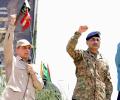
'We need to be very vigilant as we are passing through some fraught times.'

For every rupee in the government coffer, the biggest pie of 63 paise will come from direct and indirect taxes, according to the Union Budget 2024-25 documents.
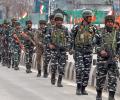
When the internal security situation spirals out of the control of the provincial law and order machinery, the CAPFs can be called in, providing a security buffer before the Army is deployed.

The finance minister continues to be backed by the same policy team in charting out the broad strategy as in the few earlier Budgets.
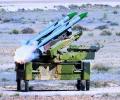
'When one air force (India's) hits the other's airbases with impunity and that air force (Pakistan's) is not able to respond, then the air force, which has put the other's airbases out of commission, has won.'

The Pakistan army has ruled out the possibility of a cut in the procurement of conventional and India- specific weapons purchase, despite a sharp increase in expenses due to operations against Taliban in the country's northwest."If you are suggesting that we should take something out of here and put it in another box that would not be a wise strategy. War on terror does require resources, but it should not be at the cost of something else," said a military spokesman.

'We've moved from thousands killed yearly in Jammu and Kashmir to 127 last year.' 'Cross-border terrorism in Kashmir is being solved. We are winning it.'

Few finance ministers announce any taxation measure that could upset the stock market. Ms Sitharaman decided to take that risk, observes A K Bhattacharya.
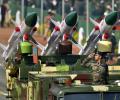
Most of the scanty 6.35% rise in the defence budget is accounted for by manpower and running expenses.

Finance Minister Nirmala Sitharaman on Wednesday said the Union Budget strikes a fine balance between growth, employment, and fiscal consolidation, and promotes cooperative federalism. Replying to the discussion on the Union Budget 2024-25 and Union Territory of Jammu and Kashmir Budget in Rajya Sabha, the minister said the government is on track to achieve the pre-announced fiscal deficit target of 4.5 per cent by 2025-26. Sitharaman, also a former defence minister, said the Agniveer Scheme to recruit people in the age group of 17.5 to 21 years, is aimed at keeping the armed forces fit, young and battle-ready.
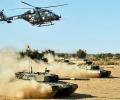
'And this will persist given the two-and-a-half-front threat we face.'
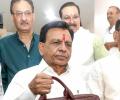
The controversy followed after another Madhya Pradesh minister, Vijay Shah, came under fire for remarks about Col Sofiya Qureshi who conducted media briefings on Operation Sindoor along with Wing Commander Vyomika Singh.
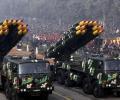
Defence exports grew 33 per cent in the calendar year 2023 (CY23) to around Rs 21,083 crore while domestic defence orders serviced by listed companies were Rs 48,000 crore. The sector is poised for steady growth. Budgeted domestic capex is likely to hit Rs 3 trillion per annum, and exports could reach $6 billion by FY29.

For every rupee in the government coffer, the biggest pie of 66 paise will come from direct and indirect taxes, according to the Union Budget 2025-26 documents. Around 24 paise will come from borrowings and other liabilities, 9 paise from non-tax revenue like divestment, and 1 paise from non-debt capital receipts, the Budget documents said.

US Vice President JD Vance called on India to drop non-tariff barriers, give greater access to its markets and buy more American energy products and military hardware. Vance, in a speech in Jaipur, highlighted the need for a stronger US-India partnership for a prosperous and peaceful 21st century. He emphasized the importance of working together to address global challenges and praised Prime Minister Narendra Modi, describing him as a "special person." Vance also urged India to provide greater market access to American products and buy more defense platforms and energy from the US. He suggested that India consider dropping some of the non-tariff barriers for American access to the Indian market and highlighted the benefits of closer India-US defense collaboration, advocating for New Delhi to procure more military hardware from the US. He cited the example of American fifth-generation F-35s, arguing they would give the Indian Air Force the ability to defend its airspace and protect its people like never before. Vance also welcomed the Modi government's budget announcement to amend India's civil nuclear liability laws, paving the way for US producers to export small modular reactors and build larger US-designed reactors in India. He emphasized the importance of energy security for India's AI ambitions, stating "there is no AI future without energy security and energy dominance." Vance's visit comes amid growing global concerns over the US's tariff war.
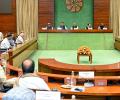
Opposition parties have called for a discussion in Parliament on the Maha Kumbh tragedy and the UP government's alleged focus on VIPs rather than the common pilgrims. Union minister Kiren Rijiju has stated that the Business Advisory Committee will decide on the agenda of the Budget Session, which will start from January 31. The Session will commence with President Droupadi Murmu addressing the joint sitting of Lok Sabha and Rajya Sabha. The Union Budget will be presented on February 1.

In an eventful week ahead, stock market investors will take cues from major events like the US Federal Reserve's interest rate decision, the upcoming Union Budget and Q3 earnings, analysts said.

The five largest exporters of major arms in 2020-2024 were the US (43 per cent), France (9.6 per cent), Russia (7.8 per cent), China (5.9 per cent), and Germany (5.6 per cent).

To boost domestic manufacturing under the Make in India initiative and reduce dependency on imports, the government is expected to announce in the Budget an increase in the minimum local content requirement for public procurement, with certain sectors being granted exceptions. Currently, firms producing goods, services, or works with at least 50 per cent local content are classified as Class-I local suppliers and are preferred the most in government procurement.

Of the total proposed allocation, over Rs 1 lakh crore is meant for BSNL and MTNL-related expenses, including Rs 82,916 crore infusion in BSNL for technology upgradation and restructuring at BSNL.

Overall market reaction to the Budget was neutral. Investors absorbed the changes to the tax rates (positive for salaried class) and capital gains taxes (CGTs, negative due to the removal of indexation and increases. Other proposals largely pertain to supporting rural development, buybacks taxed as dividends, Custom duty changes that impact multiple sectors, higher outlays for clean energy, etc. There's some moderation in the growth of capex outlay across defence, fer

Post-election capital expenditure (capex) has been weak at 2 per cent year-on-year (Y-o-Y) in M9FY25. The FY25 revised estimates (RE) indicate 7 per cent growth in FY25 against FY24, implying 21 per cent Y-o-Y growth in Q4FY25 government capex.
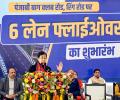
Glimpse what our politicians were doing at the beginning of 2025.
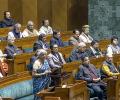
She also holds the distinction of delivering the longest budget speech at two hours and forty minutes in 2020.

'The Chinese being focussed more seawards is definitely better for India with China being the looming threat along our land borders,' says Brigadier S K Chatterji (retd).
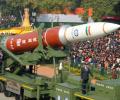
'The government must provide more funds to enable the armed forces to fight and win tomorrow's wars,' states Brigadier Gurmeet Kanwal (retd).
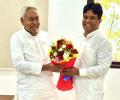

While the US continues to shell out the largest defence budget in the world year after year, other nations are slowly but certainly catching up, says the Stockholm International Peace Research Institute.
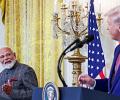
Prime Minister Narendra Modi and US President Donald Trump have vowed to move forward with plans to work together to build US-designed nuclear reactors in India. The decision was made during their meeting at the White House, where they also agreed to significantly expand energy cooperation. The move comes after India announced plans to amend its nuclear liability law and the Atomic Energy Act, which had previously been obstacles to the implementation of the US-India civil nuclear deal.

The nation has the fifth largest defence budget in the world, at $52.5 billion in 2017 ($51.1 billion in 2016), overtaking the UK whose defence budget fell from $52.5 billion in 2016 to $50.7 billion in 2017.
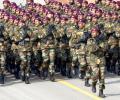
'India is ahead only of Pakistan in the amount spent on each soldier a year.' 'The Indian military is a manpower-heavy throng that is poorly armed, equipped, and trained,' observes Ajai Shukla.

India should have learnt lessons from the 1962 war but no headway was made in the development of border infrastructure till 2014, he claimed, adding that the Modi government increased the budget for the same from Rs 3,500 crore to Rs 14,500 crore.
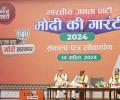
The Bharatiya Janata Party (BJP) spent Rs 1,737.68 crore for the 2024 Lok Sabha elections, according to the expenditure report submitted to the Election Commission of India. A majority of the funds were allocated to general party propaganda and candidate-related expenses, with media advertisements accounting for a significant portion. The BJP's election outreach also included extensive use of publicity materials and campaign-related travel. The party's expenditure on public meetings, processions, and rallies, including arrangements for stages, audio setups, barricades, and vehicles, stood at Rs 19.84 crore. The travel expenditure of star campaigners authorized by the party's central headquarters amounted to Rs 168.92 crore, while Rs 2.53 crore was spent on the travel of other party leaders.

The Army has now fallen behind the other two services for four years in a row.

'Market corrections are a natural part of investing, so it's essential to remain focused on long-term financial goals.'

'Consider 40% to 50% in equities, 10% in gold as a hedge, and the remaining 30% to 40% split between multi-asset funds and hybrid funds.'

Union Finance Minister Nirmala Sitharaman will present the Interim Budget on February 1 ahead of the Lok Sabha elections likely to be held in April-May.
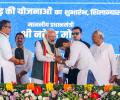
The Janata Dal (United), an ally of the ruling Bharatiya Janata Party (BJP), has sought an extension in the tenure of the Joint Parliamentary Committee (JPC) scrutinising the bills proposing simultaneous elections. The party argued that the committee, which has only met once, requires more time for extensive consultations. Meanwhile, the Lok Janshakti Party (Ram Vilas), another BJP ally, has demanded a "special industrial package" for Bihar, highlighting the state's low per capita income compared to the national average.
 © 2026 Rediff.com - Advertise with us - Disclaimer - Privacy Policy - Sitemap - Feedback - About us - Terms of use - Grievances